Well, hello! People keep asking where I've been. That is very flattering. The answer is: Everywhere! I’ve spent twenty-odd years on the road, personally inspecting condoms on six continents. But don’t worry: I did not neglect “self-care.” (Let’s just say I’ll always have Monte Carlo. And a lifetime ban from one very nice terrace.)
For the newcomers: I'm Myrtle. Global Protection Corp.® hired me in 1993 as Quality Inspector #47, and… I’ll just say it: the company has not been the same since. In 1997 I started Myrtle's Journal. People would mail me sexual health and condom questions, and I answered them with zero filter. Honestly, you all made me feel like Quality Inspector #1. 🫶 Yes, I know what an “emoji” is. I’m vintage, darling, not Victorian. My fainting couch is purely recreational.

Much has changed since then, but my passion for precision in protection hasn't aged a day.
People ask me extremely important questions like:
- “What do you mean condoms are a medical device?”
- “What on earth is a glow-in-the-dark condom?”
- “How effective are condoms?”
- “Why do condoms sometimes fail?” (Hint: mostly user error)
- “52 CONDOM SIZES? Can you help measure my member?” (Hint: no thanks, I don’t do house calls. Do it yourself – I believe in you.)
- “How do condoms get tested?”
Here’s what I can say from the factory floor: When you use condoms consistently and correctly, they are 98% effective in reducing the risk of sexually transmitted infections and unintended pregnancy. My job is making sure the condom holds up its end of the bargain—so you can focus on holding up yours. We also have a whole team of condom engineers constantly tinkering away making next generation condoms that fit and feel divine.
By way of reintroducing myself, let’s return to the topic: condom testing. It’s what I eat, sleep, and breathe about.
Fair warning: this is my entire personality, and I’ve never once had a (formal) complaint. I could talk about condom testing the way other people talk about their grandchildren. With photos.
Get in, losers! We’re going testing!
Why we test condoms
Condoms are not like cars, or mattresses, or those tiny cheese cubes on toothpicks at Costco. You can’t exactly test-drive one on the showroom floor. You need to know in advance—with absolute, ironclad mathematical certainty—that it’s going to work as intended.
The FDA classifies condoms as Class II medical devices, and they have to meet international testing standards. So top-level quality control is not just my mission in life. It’s a delightful world of very rigorous regulatory rigmarole.
Decoding the claims on the box
You’ve seen it on the packaging: “triple tested” means exactly that. Condoms are made in batches (the industry also calls them “lots”). Samples from every batch get tested twice during manufacturing and a third time once the batch is complete. A batch that can't pass the tests is discarded. (Each condom has a lot number listed on the back of the wrapper. This helps track which lot each condom came from.)
The other claim you’ll see is “individually electronically tested.” That’s the first test below, and it’s the one every single condom gets.
How are condoms tested?
1. The one test every condom gets
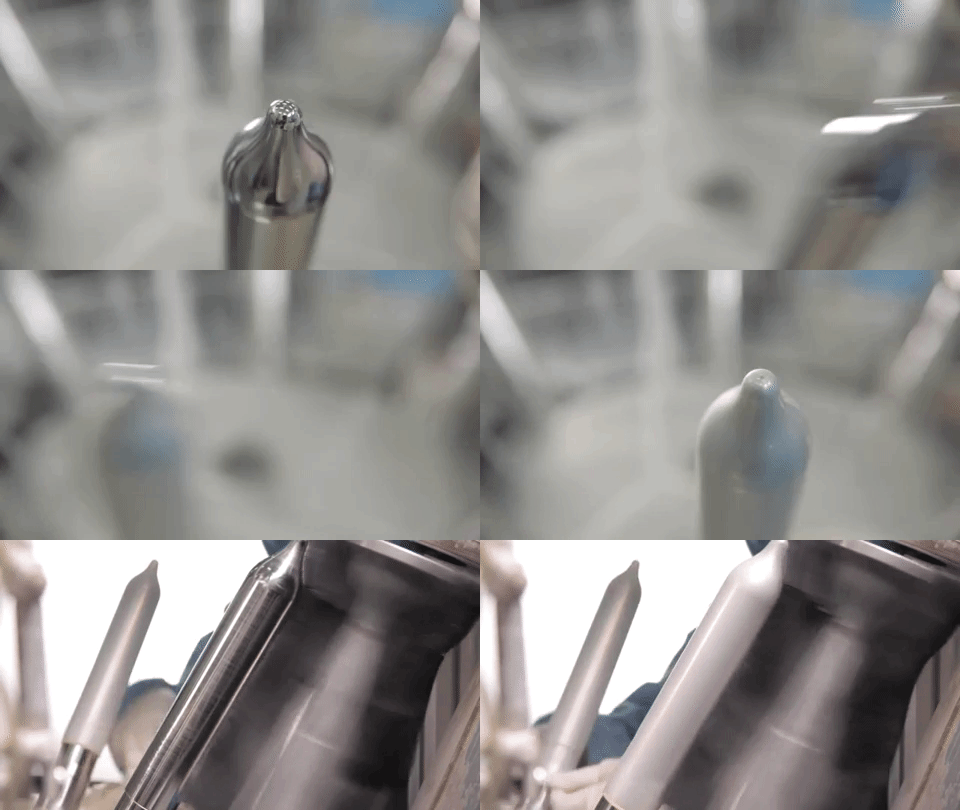
- Electronic pinhole test: Every single condom gets stretched over a metal cylinder called a mandrel and zapped with an intense electrical field. Rubber doesn't conduct electricity, so zero current should reach the mandrel. If even a microamp gets through, it means there’s a microscopic pinhole or thin spot—and the machine instantly sends that condom into the reject bin. Buh-bye; we don’t do second chances.